|
|

RBnano-HARC
Hard Anti-Reflective Coating
Transparent
materials such as glass, silica are easily scratchable and
monocrystalline sapphire reflect a significant part of the incident
light.
Most
anti-reflective coatings are formed of multilayer materials
deposited vacuum chamber (PVD). These coatings are very costly, reduce
ghost images and increase transparency but they are fragile and
sensitive to scratch and chemicals (pool chlorine for instance). RBnano
has developed an ink that allows you to lay an anti-scratch and
AR-coating on all ceramic surfaces.
RBnano
HARC is
a soluble precursor of aluminium oxide wich can be deposited by simple
spray, stamp, ink roller or soak. After annealing, the hardness and
chemical resistance are close to the bulk alumina and improve its
trasparency at least by 6% on sapphire.
Layed on the glass, coating
acts as anti-scratch and it is resistant to fluorinates chemicals. The
RBnano HARC can also be used in planarisation, microelectronics, pore
filling on lift-out and lehr rolls, high-temperature diffusion barrier
or sacrificial in crucibles.
 The
wet layer of RBnano HARC dries in a few seconds under normal conditions
of hurridity and cleanliness. Annealing of the piece between 400°C and
700°C for glass, or between 700°C and 1200°C for sapphire or silica is
required to give the hardness and strngth desired. The density of the
coating allows to suit the refractive index. Corrosion tests (soda
solution 40g/l in 24h) on sapphire showed excellent resistance to
corrosion. The
wet layer of RBnano HARC dries in a few seconds under normal conditions
of hurridity and cleanliness. Annealing of the piece between 400°C and
700°C for glass, or between 700°C and 1200°C for sapphire or silica is
required to give the hardness and strngth desired. The density of the
coating allows to suit the refractive index. Corrosion tests (soda
solution 40g/l in 24h) on sapphire showed excellent resistance to
corrosion.
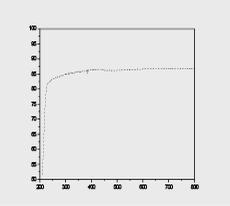
(The curve shows absorption of RBnano HARC layer on sapphire.)
Functions:
-planarization of rough surfaces
-pore filling
-anti-scratch coating on glass
-anti-reflective coating (ref.index<1.7)
-fluorinated agents protection
Usable supports:
-glass, silica glass, sapphire, silicon, ceramics
Technical features:
-colorless, mineral
-resists soda and HF
-good adhesion on all material supports
Coating application process:
-application by spray, stamp, roller ink or soak
-fast drying (from 15s to 2min)
-annealing between 400°C and 1200°C
-no heavy, toxic or polluant solvent
Fields
of application:
-electronics industry, photovoltaics
-fine glass industry (eyewear, optical precision)
-watch industry
-surface treatment (engine company, aviation)
-roll on-line, float glass
|